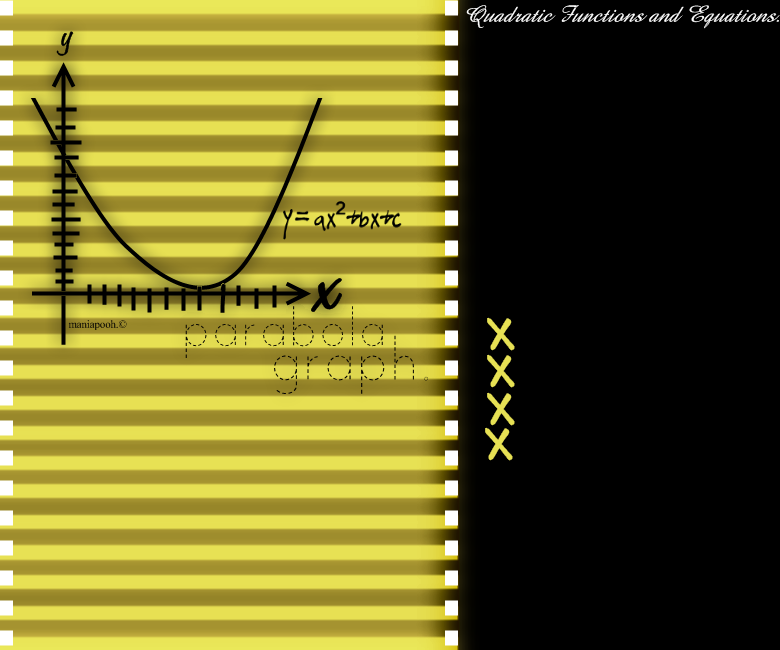
Parabola Graph.
Chapter 1: Graphing Techniques 1
1. Function:
a rule or relationship where for every input there is only one output
2. Complete Square
x^2 + bx + (b/2)^2 - (b/2)^2 + c
OR
y = a[x+(b/2a)]^2 + [c-(b^2/4a)]
3. Stationary point
dy/dx OR [(-b/2a),[c-(b^2/4a)]
4. Formula
x = [-b+(b^2-4ac)^1/2] / 2a
OR
x = [-b-(b^2-4ac)^1/2] / 2a
5. Cubic Function
positive x^3 --- graph starts from right, with "U" shape
negative x^3 --- graph starts from right, with inverted "U" shape
6. y = x^n , x is an element of real numbers (refer to notes for graphs)
Even n --- after 1, x^4 > x^2
below 1, x^4 < x^2
Odd n --- after 1, x^5 > x^3
below 1, X^5 < x^3
7. y = x^(1/n)
Even n --- after 1, x^(1/2) > x^(1/4)
below 1, x^(1/2) < x^(1/4)
Odd n --- after 1, x^(1/3) > x^(1/5)
below 1, x^(1/3) < x^(1/5)
8. y = 1/x , x is an element of real numbers and x is not 0
graph is hyperbola shape
9. y = a^x , x is an element of real number and a>0
asymptote at x axis
a>1 --- graph is exponential from left
0 < a < 1 --- graph is exponential from right
both graphs at upper axes
10. y = LOGaX , X>0 , a>0
asymptote at y axis
a>1 --- graph from negative y region curves to positive y region
0 < a < 1 --- graph from positive y region curves to negative y region
both graphs at right axes
11. y = e^x , y = lnx (reflection)
graphs of y = e^x and y = lnx are reflection of each other
12. Asymptotes
y = 1 - 1/x
horizontal asymptote (y asymp) --- 1
vertical asymptote (x asymp) --- equate x fn to 0 and solve for x
13. y = (x-a)(...)(...), where (x-a) is power 1
curve starts from right and cut through the x axis
y = (x-a)^2(...)(...), where (x-a) is power 2
curve starts from right and touches x axis first before cutting through the axis
maximum or minimum point
y = (x-a)^3(...)(...)
curve starts from right and it is a pt of inflexion first before cutting through
the axis
tve or -ve pt of inflexion
14. Ellipses
[(x-h)^2 / (a^2)] + [(y-k)^2 / (b^2)] = 1
15. Circles
(x-h)^2 + (y-k)^2 = r^2
16. Hyperbola
y = c/x
c>0 --- graph at 1st and 3rd quadrant
c<0 --- graph at 2nd and 4th quadrant
y = (ax+b)/(cx+d)
do long division
1. long division
2. asymptotes
3. intercepts